The Tokimeki Quotient: The Skill of Being Alive
Let's say you're planning to move, and you've narrowed it down to two apartments. You ask an AI tool to help you compare them, and in a few seconds it hands back a clean table covering rent, commute, square footage, the age of each building, and how much light comes in during the afternoon. The first apartment wins on nearly every row, and a friendly sentence at the bottom recommends it.
You read the recommendation and agree with it. But you also notice that something in your chest has gone a little flat, and that your mind keeps drifting back to the second apartment, the one with the uneven floor. When you looked out its kitchen window, you pictured yourself cooking there on a slow Saturday morning, and your heart gave a small flutter.
The metrics in the table were right about everything they could measure. But there was no column or way of measuring the small lift you felt at that window, and nobody else could have filled that in for you.
Takumi Kawahara, CEO of KonMari Media Inc. and Marie Kondo's husband, has been thinking about that missing column. In a short video for the Art of Tokimeki, he gives this idea a name, the Tokimeki Quotient, and argues that it's becoming one of the things that will matter most about being human.
Three ways of being good at something
Takumi starts with history.
"Throughout human history," he says, "the definition of 'excellence' has shifted several times."
In his telling, the industrial era valued the Intelligence Quotient, or IQ: the ability to calculate quickly and to reproduce what you had memorized without mistakes. Plenty of work still depends on that kind of mind.
Over roughly the past thirty years, a second measure joined it. Emotional Quotient, or EQ, is what Takumi calls "the capacity for kindness, sensitivity to others' feelings, and the ability to build good relationships." He ties its rise to the internet, which spread teams across many settings and ways of working until what made them productive was whether people felt safe with one another.
Now AI can out-calculate any of us and can even simulate care. So Takumi asks what is left that belongs to people alone, and his answer is a third quotient: TQ, the Tokimeki Quotient.
The Tokimeki Quotient and what it measures
Tokimeki literally translates to "spark of joy" in Japanese. It's the feeling behind Marie Kondo's famous question, "does this spark joy?" The word describes the response your body has to something you love: that small lift in your chest when something feels right, the feeling of yes, I want more of this. It tends to arrive before you can even explain it in words.
TQ is the intelligence of that feeling, which we describe as the ability to hear the voice of your own heart, know what truly matters to you, and choose it.
Takumi's definition is "the ability to choose things through the lens of Tokimeki."
An AI system can offer a reasonable answer to almost anything, but it has no inner feeling that says I love this, and Takumi believes that gap will bring TQ to the forefront of the human experience. He expects it to become one of the key criteria for what is expected of people, "in education, in hiring decisions, and in how we measure prosperity and success." You can already see a small version of this in everyday life, like with the apartment table: a machine gives you a sensible answer, and it's still up to you to decide whether that answer feels right for you or not.
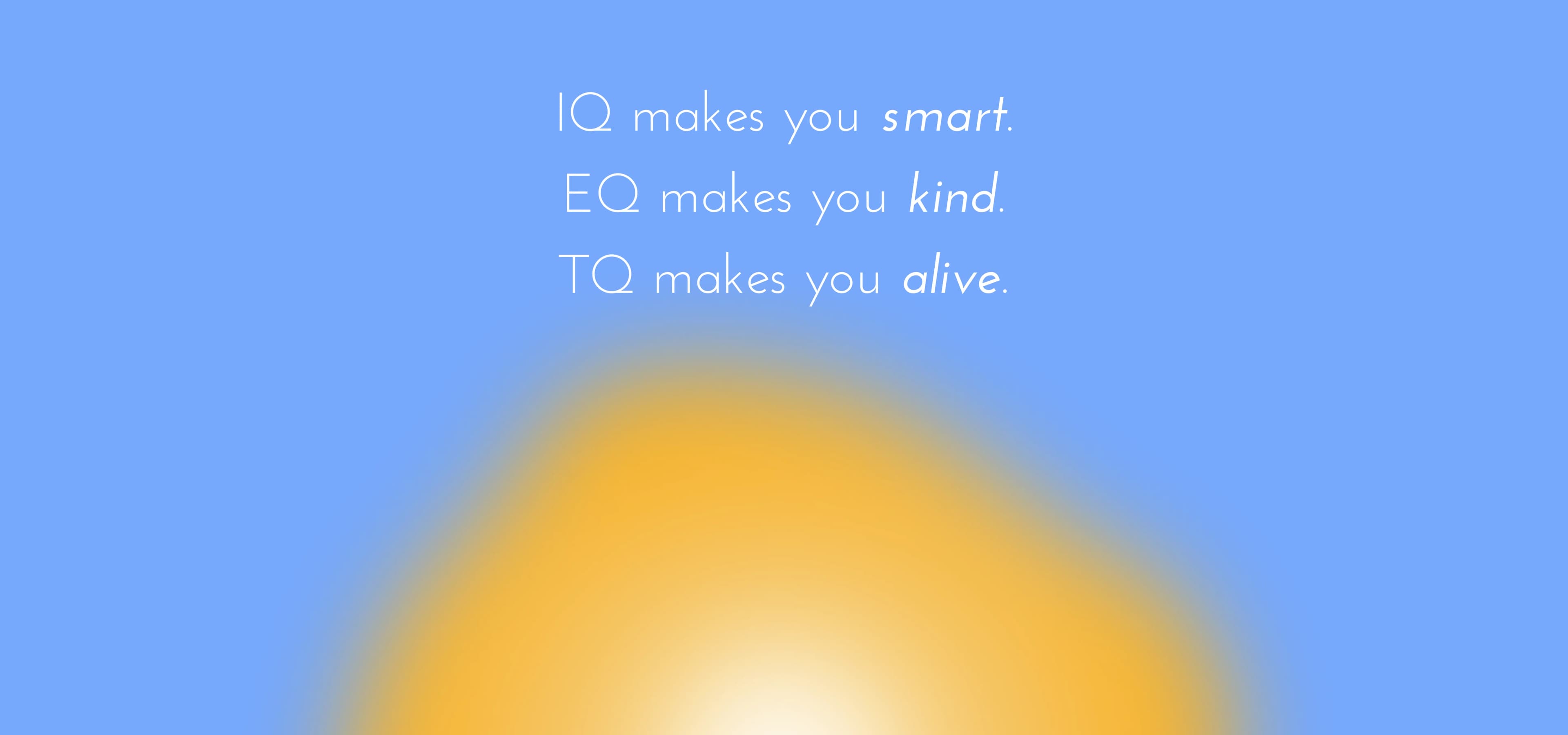
When we shared this idea on Instagram in July, we put it in three lines: IQ makes you smart. EQ makes you kind. TQ makes you alive.
A quotient with no answer key
Quotient is a word borrowed from IQ and EQ, so it's only natural to picture a test with a score at the end. But Takumi describes TQ in almost the opposite terms. He calls it something felt and difficult to put into words, and he adds that it's impossible to call any of it a "right answer."
Takumi spoke in Japanese, and his word for "right answer" is seikai (正解), the same word you'd use for the correct answer on a test. His complete definition of TQ turns that word around.
TQ is "the ability to choose things through Tokimeki," he says, "and then to make those choices your own right answer."
With TQ, the answer gets written after you choose, through the way you live with what you chose.
There's no answer key for TQ because the answer is personal. What sparks Tokimeki for one person might leave someone else cold, and what lifts you at twenty-five might mean very little to you at forty. The ninth of our 10 Disciplines of Tokimeki says it plainly: Tokimeki is different for everyone. So the practice becomes finding the right answer that belongs to you, and letting it change as your life does.
Like Tokimeki itself, TQ is something you already have. Your body has been responding to what it loves since long before you had language for it. What grows with practice is how clearly you hear that response and how far you're willing to trust it, a bit like a compass you've carried for years without checking, which works but still needs some fine-tuning before you take it on a long walk.
For Marie and Takumi, the KonMari Method is the foundational practice for all of this. Marie's method asks you to hold each thing you own and ask that question, one category at a time, and Takumi believes that what people were building through all that sorting was their sensitivity to Tokimeki, "their ability to discover what they truly think and what they love." We wrote about how you can hone that sensitivity in Sharpening Your Tokimeki Sensitivity.
Where TQ shows up
Once you know the feeling, you might notice how many choices you make with it, or around it. It might be at work, in an offer that looks excellent on paper and leaves you oddly unmoved. It might be at home, or in a Sunday and how you choose to fill it.
It might be in something you make, the project you keep returning to after everyone else has gone to bed. And it might be in the small, everyday choices that apps now make for you, like which show to watch next or which route to drive, where it's easy to go along with the suggestion without stopping to ask what you'd actually prefer.
Takumi has seen versions of this across many people who finished the KonMari Method. Some changed careers or started new businesses, and others began choosing their relationships by the same standard and found themselves living among people who resonated more with them. When he and Marie looked at why, they concluded that what had grown in each case was TQ.
TQ in relationships
We spent the month of September focused on applying Tokimeki to relationships, and they're a helpful place to see how EQ and TQ differ. EQ tunes you to the other person, to their mood and what they might need. TQ turns that same attention within yourself while you're in the room with them.
Marie has spoken about this in the context of romantic relationships.
"I think the process of really sensing and observing your own state, how you feel when you're with that person, becomes incredibly important," she says.
With practice, she explains, you begin to tell whether a feeling is "coming from anxiety, like 'I want to be married by a certain age so I can't let this person go,' or whether your body is truly relaxed and feeling happy." She has noticed something about the people we already love, too.
"Even if the other person isn't perfect according to the conditions you had in mind," she says, "you start to be able to see things like 'this part of them is wonderful' or 'this is something we can grow together on.'"
That's the second half of Takumi's definition at work, where a choice becomes right through how you tend it.
This doesn't mean abandoning common sense. The comparison table is still useful, and a feeling about a kitchen window doesn't fix a leaky roof. Takumi presents TQ as a new axis alongside IQ and EQ, and most good decisions have room for all three.
The courage it asks for
If the feeling is already there, you might wonder why so many of us talk ourselves out of it. Marie has an answer from years of tidying alongside clients.
"There are actually many moments where, intuitively, the answer of 'this sparks joy' or 'this doesn't' has already come," she says, "but overthinking gets in the way."
AI can make that overthinking easier to act on. A well-reasoned answer is always a few seconds away, and it comes with reasons you can repeat to anyone who asks. The choice your body leans toward usually comes with nothing but a feeling, which is much harder to put into words. Picture telling your partner you'd like the apartment that lost on almost every metric of the table, because of how you felt standing at its kitchen window.
Sometimes the difficult part comes later. The apartment with the good window turns out to be cold in January, and you have to decide whether you'll make it your right answer anyway, with a thicker rug and the kettle on more often. That takes a kind of courage nobody sees from the outside.
It's fine if that courage comes slowly. Marie begins tidying with clothes, the easiest category, and leaves sentimental things for last, because sensitivity to Tokimeki "is something you build up through practice." At the Art of Tokimeki, we take that same order beyond the closet, into your work, your relationships, and every other aspect of your life. You start with choices where little is at stake and let the larger ones wait until you trust what you hear. Each small choice made this way, Marie has found, adds a little confidence in your own judgment, and you don't need to make a big life change for the practice to count.
Practicing TQ this week
Here is a small experiment. Three times this week, when you're about to ask a search bar or an AI tool to help you choose something, stop before you type. It might be about getting a restaurant recommendation or the wording of a slack message.
Open the notes app on your phone and write down which option you're already leaning toward, plus one word for how that lean feels. If you're choosing somewhere for dinner, your note might say the little Thai place, excited. Then go ahead and ask your AI tool for help, and as you read the answer it gives, pay attention to what your body does. You might feel relieved, or you might feel a little flat, as we described in our apartment example earlier.
At the end of the week, look back at your three notes. Some of the time your lean and the recommendation will have matched. Where they didn't, you don't have to do anything about it yet, noticing the gap is enough for now.
If you'd like to stay with it longer, here are four questions to take to your journal:
- If an AI agent could handle every task in your week starting tomorrow, which one would you still want to do yourself? How does it feel to imagine keeping it?
- What is one thing you love that would be hard to justify on paper? When you picture explaining it to the most practical person you know, what happens in your chest?
- Think of someone whose moods you can read almost perfectly. The next time you're with them, what do you notice about your own state, and how does it feel to turn that attention toward yourself?
- Is there a choice you made by following your Tokimeki that turned out harder than you expected? What have you done since to make it your right answer, and how does it feel to give yourself credit for that?
There are no wrong answers here, and nothing you write has to turn into a decision.
Keeping an eye on TQ
Takumi ends his video plainly. "Each of us lives only one life," he says, and he asks anyone who wants to live that life by what they love, in a time of fast change, to keep an eye on TQ.
The easiest way we can help you keep an eye on it is the Weekly Tokimeki Question. Each week, Marie asks one question and answers it first, and then she invites everyone else to share. This week's question is live now, and we'd love to read your answer.
You can take part on Instagram or X, and you'll find everything else we're building at artoftokimeki.com.