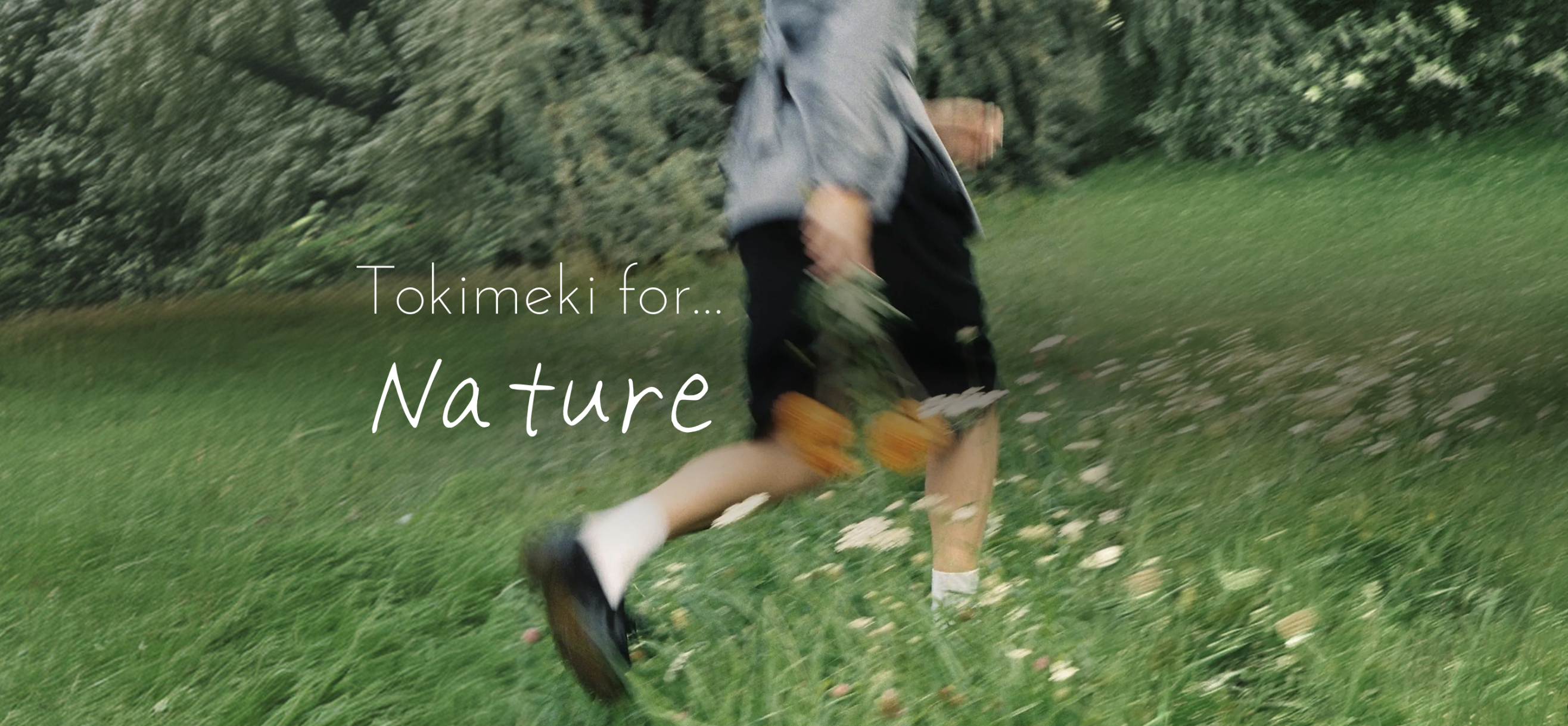
October Roundup: Finding Tokimeki in Nature
October 2026
In October, we took the Weekly Tokimeki Questions outdoors. After last month's focus on the people we love (if you missed it, you can catch up in our September Roundup), we turned our attention this month to seasons, landscapes and the little moments in nature that lift you before you've had a chance to think about why. Your answers took us to beaches and mountain paths, to a mandarin tree in a garden in Japan, and to a neighborhood tree that one mother says watched her son grow up.
We read every single one of your answers, usually more than once, and reading them inspired our whole team to notice more on our own walks and time in nature. We're grateful to everyone who shared, because you helped us feel a little more of that Tokimeki spark in the world around us.
Marie set the tone in the first week with a line about the end of summer.
"I love the cool evening breeze that comes as the hot summer ends," she says. "It always gives me a flutter of excitement, a flutter of Tokimeki."
In a short video, she described how that flutter tends to arrive before she has consciously registered the change in the air.
"My body knows," she says, "before my mind does."
The season that feels like yours
Our first nature question was one most people can answer in a second:
What season sparks the most Tokimeki for you, and why?
Marie picked autumn.
"Autumn fruits, like pears and persimmons, are so sweet"
And she loves Otsukimi, the Japanese tradition of gathering to view the autumn moon.
"Everything about this season," she says, "brings a little, little Tokimeki."
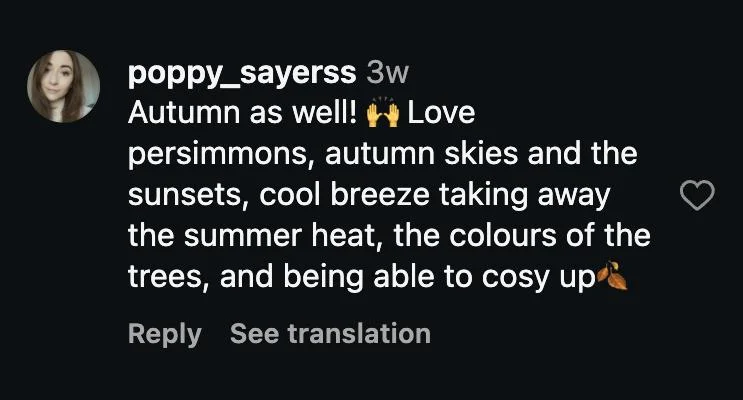
Poppy agreed with Marie, persimmons included. She also loves autumn skies and sunsets, the
"cool breeze taking away the summer heat," and finally "being able to cosy up."
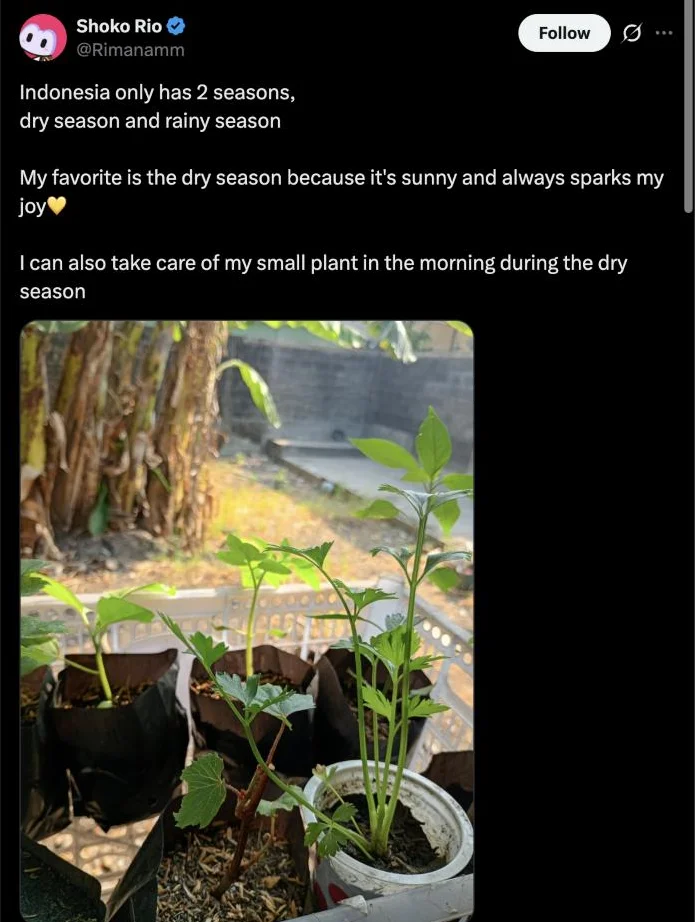
Shoko wrote that Indonesia has only two seasons, dry and rainy, and the dry one wins, because
"it's sunny and always sparks my joy."
It's also when Shoko can look after a few small plants in the morning, and the photo shows exactly that: a row of young seedlings in small black grow bags and a white pot, lit by the morning sun, with banana trees behind them.
What struck us was how specific your answers were. You told us about the smell of apple pie and cinnamon rolls, the scent of the ocean, the color of the trees, and pulling on warm clothes again for the first time. A favorite season turns out to be a collection of small moments like these, and the ones you look forward to most are a good record of what moves you. Our community collage of favorite seasons has more of your answers.
Ocean, mountains, or forest?
The second week asked you to choose your Tokimeki element:
Ocean, mountains, or forest? Which sparks the most Tokimeki for you?
Our post offered a little meaning behind each one. People drawn to the ocean often love movement and open horizons, the mountains tend to pull people who want perspective and a bit of challenge, and the forest draws people who love quiet moments and finding hidden beauty.
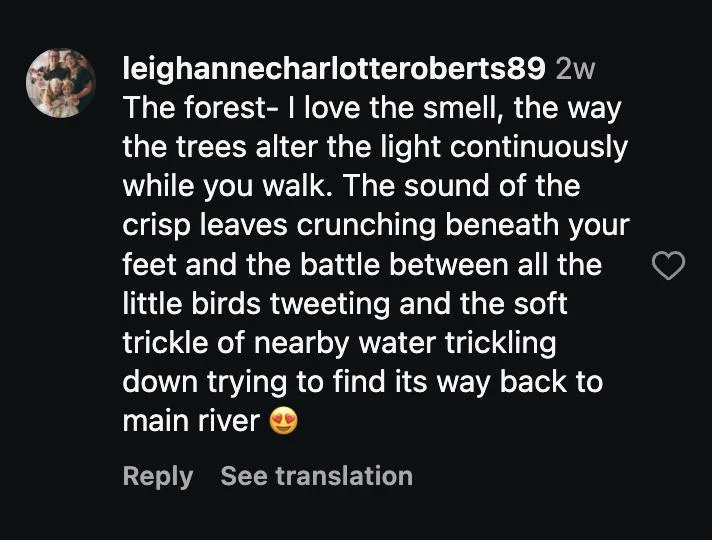
Leighanne chose the forest and took us on a whole walk through one: the smell, the way the trees "alter the light continuously while you walk," the crisp leaves crunching underfoot, and the birds competing with the sound of nearby water "trying to find its way back to main river."
Kelly went the other way.
"Any body of water is the home element of my Tokimeki," Kelly wrote. "Teal is a calming color, and the feeling of warm places with the sound of waves crashing is what peace and joy mean to me."

The ocean came up more than anything else, and many of you were exact about which part of it you love. "I don't like being IN water," Tamara wrote, "but I love being at the water." Tamara knows that a swim won't spark joy for her but time by the water will, and knowing your Tokimeki that precisely makes it much easier to choose more of it. Our X collage gathers more of your ocean, mountain and forest picks.
How you like to spend time outside
The third question asked about habits rather than places:
What's your Tokimeki way to spend time outside?
Marie's favorite is "a very slow, relaxed walk, no rushing." She looks at the wildflowers along the path and feels the breeze.
"That simple time helps me feel at ease," she says. "It makes it easy to hear my inner voice clearly."
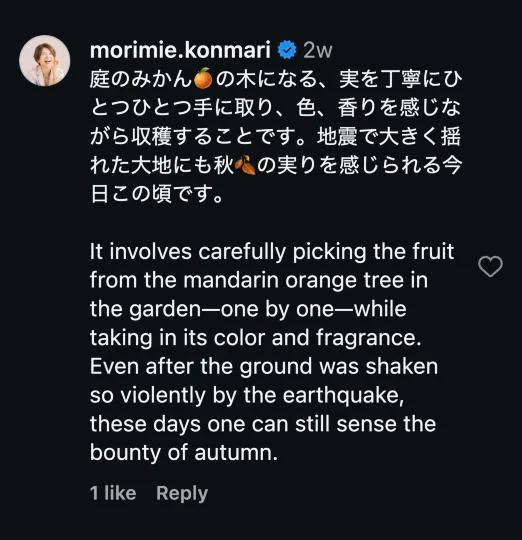
Mie shared a seasonal ritual from her garden in Japan. She picks the fruit from her mandarin tree "one by one," taking in each one's color and fragrance as she harvests it. She added that even after an earthquake shook the ground so hard, "one can still sense the bounty of autumn" these days.
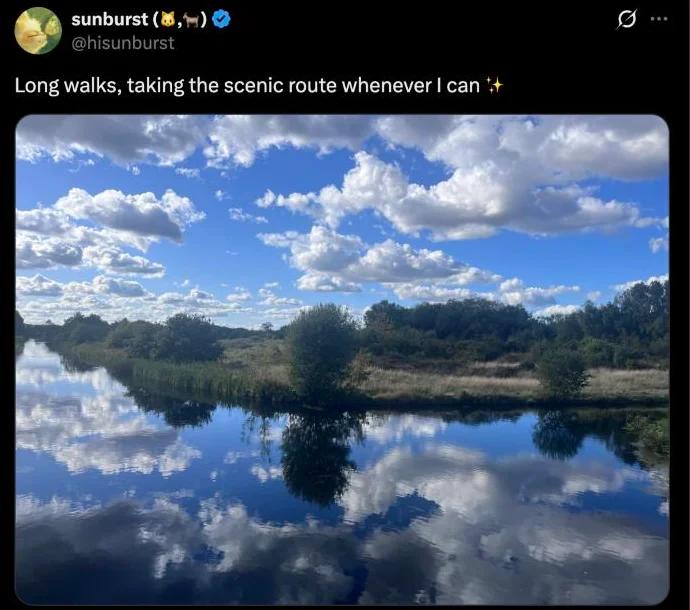
Sunburst's way to spend time outside is
"long walks, taking the scenic route whenever I can."
Sunburst shared a photo from one of those walks, of a still river reflecting a bright blue sky full of white clouds so clearly that it looks like two skies, with reeds and trees along the bank.
Most of your answers were walks of one kind or another, a lot like Marie's. Melinda likes "a morning run when everything is quiet and peaceful." Some of you walk through tree-lined streets with your favorite music on, and some stop to say hello to "lil furry friends along the way." None of these needed a special trip or any equipment, and because they fit into everyday life, they give you a chance to notice what lifts you almost any day of the week. This week's collage has more walks, runs and slow mornings outside.
A plant you'd know anywhere
We ended October with a question about the living things we notice most:
What's your Tokimeki plant, flower, or tree?
The post asked you to think about what makes yours special, whether that's a memory, its color, its scent, or simply the way you feel around it.
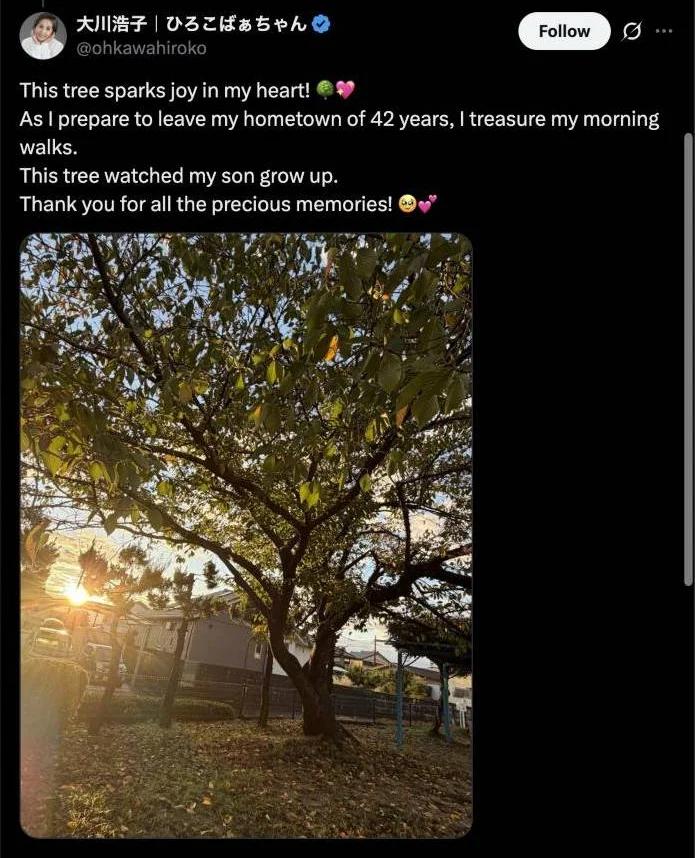
Hiroko shared a tree from her morning walk.
"This tree watched my son grow up," she wrote.
She is getting ready to leave her hometown of 42 years, and wanted to thank the tree "for all the precious memories." In her photo, the low sun comes through its wide branches, the leaves are just starting to turn, and fallen leaves cover the ground beneath it, with the houses of her neighborhood behind.
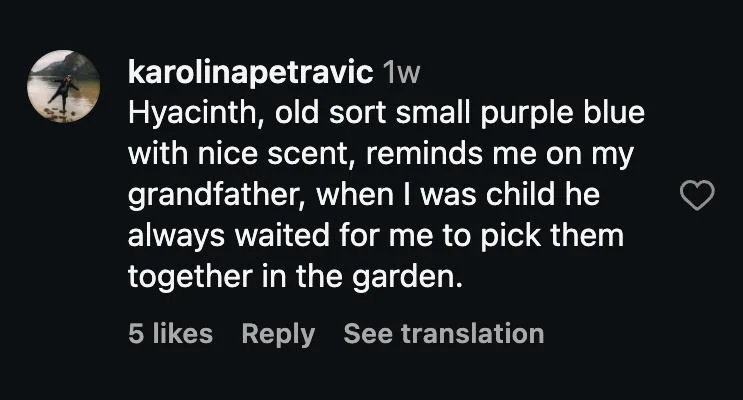
On Instagram, Karolina chose an old variety of small purple-blue hyacinth with a lovely scent. It reminds her of her grandfather, who, when she was a child
"always waited for me to pick them together in the garden."
Sunflowers, lavender and tulip trees all came up, but what we noticed most was how many of your plants led back to a person: a grandmother's gardenia on a rainy evening, an orange blossom that recalls an old neighbor, a flowering shrub from a childhood home in the Philippines. Karolina's grandfather waited for her so they could pick the hyacinths together, and decades later the flower still carries both of them.
Sometimes what sparks Tokimeki in nature is tied up with whoever was beside you when you first noticed it. You'll find more of your plants, flowers and trees, and the stories behind them, in the community collage.
More from October outdoors
Outside of our weekly questions, most of what we shared in October was about slowing down outside and noticing more while you're there. Late in the month, Marie shared a few of the ways she finds Tokimeki in nature: morning walks with her husband Takumi, sharing small moments as they go, and on other days silent walks to clear her mind, or shinrin-yoku, forest bathing, the Japanese practice of slowing down among trees and letting your senses lead.
If you'd like to try forest bathing yourself, our guide walks you through it one sense at a time. Tokimeki for Nature suggested adding a question or two to the usual ones about the weather and the view, like whether you feel more like yourself outside, and a few days later our post on perspective took common outdoor complaints and turned them around, so that "The weather ruined my plans" became "The weather gave me a different way to experience the day." In our nature wordsearch, breeze was the word that caught your eye most often, and Tokimeki in the Wild gathered photos of Tokimeki moments in nature taken by some of the KonMari consultants in our community.
The last three of the 10 Disciplines of Tokimeki ran in October too: sparking joy takes courage, Tokimeki is different for everyone, and yourself, your circle, the world, the idea that joy you notice in yourself tends to reach the people around you and keep going. You can read all ten in our blog post on The 10 Disciplines of Tokimeki.
Tokimeki in London
In October, Tokimeki also came to London. Marie headlined Home, Life & You live at ExCeL with a talk officially introducing the Art of Tokimeki on stage, and she opened with the story of how she came to tidying in the first place. Even as a child, clearing and tidying spaces gave her great satisfaction, but for a long time she tidied by asking what to get rid of and what she didn't like, and the stress of it built until she fainted. Afterward, she came to see how much that focus on the negative had been weighing on her, and that when you focus on the things that make you happy, you start to enjoy the process. Out of that came the realization that we all have an inner spark telling us what matters, and that spark is Tokimeki. The Art of Tokimeki takes the question she has been asking for more than ten years, "does this spark joy?", beyond the home and into your work, your relationships and the decisions, big or small, that shape a life.
Marie described Tokimeki as the inner spark that tells you something matters, and as a sense that gets stronger the more you rely on it.
"I think of it like a muscle," she said. "The more that you use it, the stronger it becomes."
If you feel out of touch with what sparks joy for you, she suggested starting small, with questions like what you want to eat today, what color you feel like wearing, or who you'd love to spend time with. You ask, you feel, and you notice, and each time you choose what sparks joy, you become a little more confident in choosing what matters to you.
Alongside the talk, we spent the day at our first-ever Tokimeki booth. The centerpiece was the Tokimeki Tree, where visitors chose one of three questions, wrote their answer on a card and hung it on a branch, and by the afternoon the tree was covered in small moments of joy. Going through those cards was the best part of the day for us. We also had a calligraphy session where people could choose an intention, like "cherish," "savor" or "Tokimeki," then watch our calligraphy master write it out for them by hand and take it home. Everyone went home with a Joy Checklist for the days after.
If you couldn't make it to London, you can try out the questions from the Tokimeki Tree activity at home too. There was one for each of the conference's three themes, home, life and you: what in your home sparks joy the moment you see it, what sparked joy for you this week, and what's one thing you do for yourself that sparks joy. Pick one and write your answer somewhere you'll see it this week.
Here's a look around the booth.
The impermanence of nature
Noticing Tokimeki outdoors comes with an interesting dynamic around impermanence, since almost everything you notice will change at some point. The leaves you love will be on the ground in a few weeks, the cool evenings turn cold, and the light that stopped you on your walk is gone by the next day. Some of this month's answers held more than a change of season. Hiroko is saying goodbye to a tree she has walked past for most of her son's life, and Mie wrote about autumn fruit on ground that an earthquake had shaken hard.
Japanese has a phrase for the feeling that comes with this, mono no aware, a gentle sadness at how things pass. Our post on Tokimeki and mono no aware looked at how the two fit together: Tokimeki asks what is moving your heart right now, and mono no aware asks whether you can feel it fully while knowing it will change.
When we asked about your favorite season, a community member who found herself back in autumn after four years of living in the tropics said she loved it for "the beautiful reminder of impermanence."
The changes we notice in nature have a way of mirroring the ones happening inside us, because what sparks Tokimeki for you changes too. A morning run that used to set you up for the whole day might slowly start to feel like a chore, and the same thing can happen with work you once loved, a weekly habit, or a relationship that used to light you up. That can feel like losing something, though more often it means your sensitivity is doing its job and telling you what fits now. You don't have to hold on to an old answer or have a new one ready, and it's fine to notice what's here this week and leave it at that. What we can practice is noticing what gives us that spark right now, and then cherishing it fully while we have it, knowing it might not always be there.
A practice for this week
Each prompt picks up one of October's questions, so you can carry the month a little further on your own.
- Our first question asked which season sparks the most Tokimeki for you. Think of the very first sign that your favorite season is arriving, like the evening you first reach for a jacket. How does it feel to imagine catching that moment while it's happening this year?
- When we asked ocean, mountains, or forest, many of you named one specific thing you love about it, like the sound of waves or the way light moves through the trees. Think of the place you'd choose and the one detail you love most about it. How does it feel to picture that detail right now?
- We asked about your Tokimeki way to spend time outside. Think of the last time you came back indoors a little lighter than when you left. What were you doing just before that feeling arrived, and how does it feel to remember it now?
- When we asked about your Tokimeki plant, flower, or tree, so many answers led back to a person. Think of a plant that reminds you of someone. How would it feel to show it to them, or to tell them about it, this week?
If you'd like something hands-on, try this. Sometime this weekend, take a twenty-minute walk somewhere with trees and bring home one small thing that has already fallen, like a leaf, an acorn, a pinecone or a smooth stone. Put it where you'll see it every day, on a windowsill or your desk, and leave it there for seven days. Each time it catches your eye, notice whether the small lift is still there. On the seventh day, decide whether to keep it, or take it back outside and let it go with a thank-you.
There's no need to do all of these. Start with whichever one you're drawn to and save the rest for another week.
Join us every week
Every Wednesday we share a new Weekly Tokimeki Question. Marie shares her own answer to get things started, and anyone who wants to can join in through the comments on Instagram or by quoting the post on X. Then we compile your answers into a community collage, and at the end of each month we bring them together in a roundup like this one.
In November, we're turning to family, and to the recipes, objects and rituals that get passed down. The first question of the month is live now.
Want more? Follow us on Instagram or X, and read more at artoftokimeki.com.